
Wednesday, August 13, 2014
The Abbey of St. Michael de Cuxa

Thursday, July 24, 2014
Knocking on Heaven’s Door

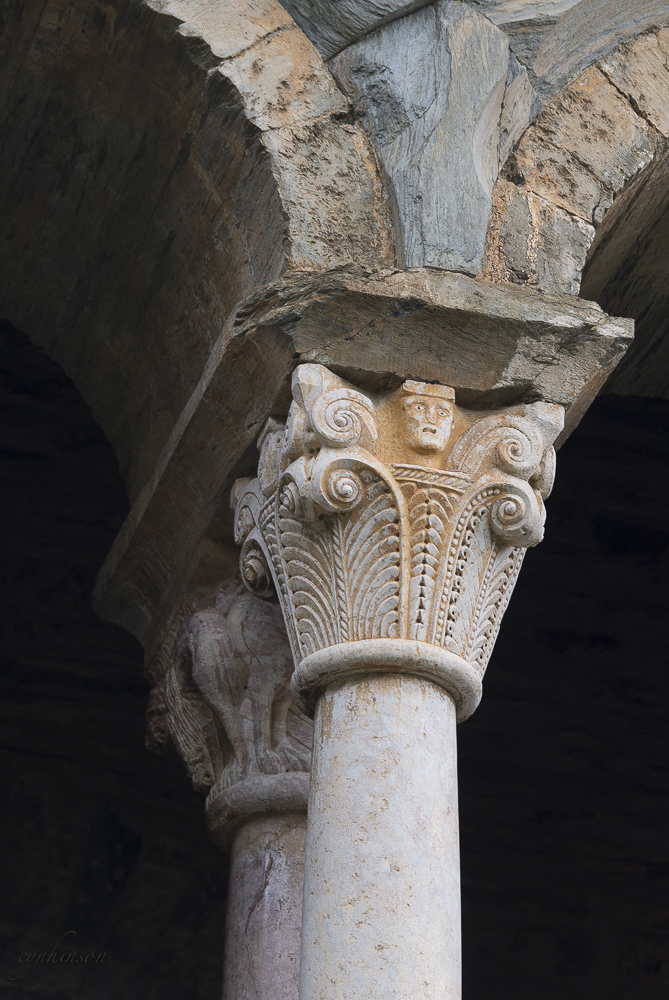

The Pyrenees is a wild region with small villages clinging precariously to mountain slopes and oppressive fortifications from the long struggle between France and Spain. Despite the rocky, in places almost lunar, landscapes, the area has been inhabited since prehistoric times. Today, life in these remote mountain villages can be inconvenient, but in the Middle Ages it must have been unbearable:
cold, barren and isolated.
So what better place to put a monastery? If your professed
intention was to get away from it all, to remove yourself from worldly
temptation and to work hard for the Lord, no place could have been more fitting
than the Pyrenees. And sure enough, on our recent visit we found that everywhere we looked, on nearly every peak, no matter how isolated, there was a church, chapel, hermitage,
monastery or abbey. Of these, one of the most noteworthy is the Priory of Sainte Marie de Serrabone.
Thursday, May 15, 2014
An Oriental Palace

Because we talk about the Alhambra, in singular form,
it sounds as if it’s one building. But the Alhambra was actually a royal city,
a fortified complex of palaces, mosques, schools, workshops and farms capable of supporting 40,000 people. Not surprisingly, given its turbulent history, the fortress that we see today bears only a passing
resemblance to the Nasrid’s medieval stronghold.
Like the Great Mosque of Cordoba, the Alhambra was significantly altered after Spanish troops conquered Granada in 1492, beginning with the Christian purification rites that stripped away the Islamic religious symbols. Thirty years later, several original buildings were demolished to make way for Charles V's enormous Renaissance palace, which now sits so ponderously amidst the remaining Moorish architecture. In subsequent centuries, earthquakes, neglect and occupying troops took an additional toll. Finally, in the mid-19th century, after the Alhambra's delights were once again brought to the world’s attention, a number of imaginative “restorations” destroyed what several centuries of neglect hadn't.
 |
| The Alhambra (on the left) with Granada visible in the distance. |
Tuesday, May 6, 2014
The Middle of Paradise
"Leave me in Granada in the middle of paradise where my soul wells with poetry:
Leave me until my time comes and I may intone a fitting song..."
José Zorrilla
José Zorrilla

For the next couple of weeks archi-trouve will be moving to Granada to report on the Alhambra - that masterpiece of Andalusian architecture. But before jumping into architectural descriptions, I’d like to explain a little more about the Moors’ uneasy conquest of the Iberian Peninsula. (And for those of you who have hated history since the 7th grade, I've included several pretty pictures of the Alhambra.)
Friday, April 25, 2014
The Grand Mosque of Cordoba
We recently spent two weeks exploring Andalusia, the area in the south of Spain that was occupied by Islamic Moors for about 800 years. Now, I went to Alhambra High School, and was a junior varsity cheerleader for the mighty Moors. And despite the soul-searing disappointment of never becoming a VARSITY cheerleader, I remained fascinated by the Moors and their conquest of Andalusia. But it wasn't until I started reading up for our trip that I learned the full extent of their contributions to European civilization. (Goooooooo Moors!)

Many historians have argued that Spain reached its high point, both politically and culturally, under the Moors. During their occupation, which spanned from approximately 700 to 1500, dozens of important mosques and universities were constructed, along with schools and libraries that were open to the public. Music and poetry were highly regarded, and mathematics, medicine, astronomy and physics were studied. Granada, Seville and Cordoba grew into large cities with diverse Muslim, Jewish and Christian populations who practiced their religions freely. In short, "while Europe was languishing in the depths of the Middle Ages, a far superior culture was thriving in Andalusia."*
Tuesday, April 1, 2014
La Maison d'Adam


Bruce and I first saw Adam’s house in about 2002 on our
first trip to Angers, and it made a lasting impression on both of us. I
remembered it because, despite the age of the house, it retains dozens of beautiful carvings; Bruce remembered it
because one of the carvings is quite risqué.
Tuesday, March 25, 2014
Rocks in My Head

We recently spent a long weekend in Angers, a lovely small
city in the Loire Valley that we thought might be an interesting place to live*.
While planning for the trip I
took a look at the Michelin map to figure out the most interesting
route. Now, you have to understand that the Michelin maps are much more than simple road maps. In addition to showing all the
highways and byways of France, they point out such interesting sites as silos, (Silos? Bruce and I are still discussing the reasoning behind this.) bridges, chateaux, factories, abbeys, war memorials, spas, ruins, picnic grounds and dolmens. You’ve got to love a map that includes dolmens.
What, you might be asking, are dolmens? Simply put, they're rooms or
chambers made out of huge flat rocks. They’re found in nearly every
European country and as far east as China and Korea. Built during the Neolithic
period, the oldest dolmens in Western Europe are about 7000 years old.
Archaeologists aren’t exactly sure who built them or why. Most are oriented on an east-west axis and therefore have some connection with the rising and setting sun. Human bones and
artifacts such as pottery shards have been found inside some chambers, leading one school of scholars to believe that the dolmens served a funerary
purpose. Others believe that this is not the case; the bones often date to later
periods, indicating that the chambers were re-used as tombs, long after their
initial construction. In the
case of the Loire Valley dolmens, no bones have been found at all. It’s these mysteries surrounding the dolmens that make them interesting to so
many people, myself included.
Subscribe to:
Posts (Atom)